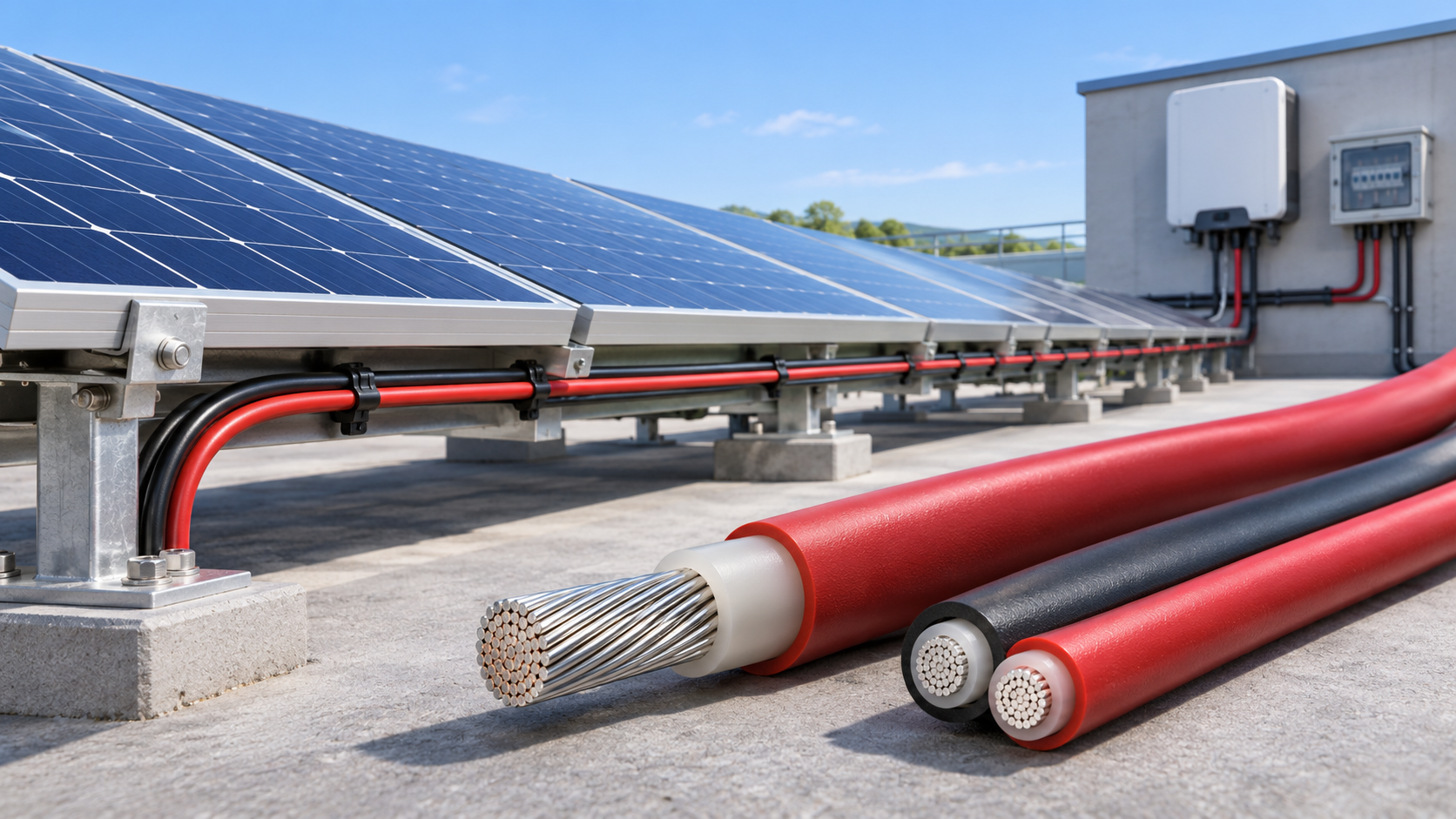
PV1-F cable is built for years of outdoor DC service, not simply for carrying current between two terminals.
A solar cable may look like an ordinary red or black single-core wire, but its working environment is very different. On a rooftop or utility-scale solar array, the cable can face direct sunlight, temperature changes, ozone, moisture and long-term outdoor exposure. It may remain in service beside photovoltaic modules for years with limited access for maintenance.
Ordinary equipment wire can carry the same current in a protected cabinet, yet still be unsuitable for this environment. PV1-F solar photovoltaic cable uses a purpose-built combination of flexible tinned copper, cross-linked low-smoke zero-halogen insulation and an outer protective layer. The complete construction—not just conductor size—is what makes it suitable for compatible indoor and outdoor PV wiring.
This guide explains the differences, selection factors and installation details buyers should review before ordering solar cable.
PV1-F is a flexible photovoltaic power cable designed for solar DC connections. Rolan Cable's current product is rated 600/1000V and is available in single-core and red/black twin-parallel versions.
Its published construction includes:
The product range includes single-core sizes from 1.5 mm² to 16 mm² and twin-parallel configurations from 2 × 2.5 mm² to 2 × 6 mm². Red and black colors support polarity identification.
| Selection point | PV1-F solar cable | Ordinary protected equipment wire |
|---|---|---|
| Main environment | Indoor and outdoor PV systems | Cabinets, equipment or protected building wiring |
| Conductor | Flexible tinned copper | Bare or tinned copper, product dependent |
| Insulation system | Cross-linked LSZH insulation and outer protection | Often PVC or another single insulation layer |
| Sunlight and UV | Designed for outdoor solar exposure | Not automatically UV resistant |
| Ozone and weather | Intended for demanding outdoor conditions | Product-specific; often requires protection |
| Temperature range | Published range approximately -40°C to +150°C | Depends on wire type and installation |
| Standard colors | Red and black | Many colors according to application |
| Typical function | PV module, string and DC equipment connections | General power, control or internal wiring |
An ordinary wire should not be substituted merely because its conductor cross-section and voltage appear similar. The approved standard, insulation system and environmental tests must also match the installation.
Bare copper conducts electricity well, but its surface can oxidize when exposed to heat, moisture and contaminants. Tinning applies a thin protective metal coating to the individual strands.
For solar cable, tinned copper provides several practical benefits:
Tinning does not make a connection waterproof. The connector, crimp, seal and enclosure must still prevent moisture from entering the conductor interface.
Cross-linking changes the polymer structure so it resists heat and deformation better than an ordinary thermoplastic compound. LSZH means low smoke zero halogen, describing material behavior intended to reduce smoke and halogen emissions compared with many conventional halogen-containing materials.
In PV1-F cable, the cross-linked insulation and outer layer support:
Material names alone do not prove compliance with a specific project standard. Buyers should request the applicable test and certification documents required for their market.
Solar modules may operate for decades. Cables beneath the array experience repeated heating during the day and cooling at night. They may also be exposed to wind-driven movement, moisture, dust, salt or industrial pollution.
An indoor PVC wire installed outdoors can harden, fade or crack if it lacks the necessary sunlight and weather resistance. Damage may not be visible until insulation performance or conductor protection has already deteriorated.
PV1-F is designed around this exposure. Even so, correct routing remains essential. A solar cable should not lie against sharp roof edges, remain submerged in standing water or hang unsupported from a connector.
Conductor size depends on current, cable length, voltage drop, installation temperature and grouping. Solar arrays produce DC current for long periods, so unnecessary conductor loss directly reduces delivered energy.
Review:
A larger conductor reduces resistive loss but increases cable diameter, weight and cost. Use a documented cable calculation rather than selecting the same size for every array.
Single-core red and black cables offer flexible routing because positive and negative conductors can follow separate paths where the design permits. Twin-parallel cable keeps the two insulated cables joined side by side, which can simplify handling and keep the circuit pair organized.
The twin construction does not change polarity requirements. Each side remains a separate insulated conductor, and the installation must follow the connector, routing and separation rules in the project design.
Choose based on:
Rolan offers standard twin-parallel sizes of 2 × 2.5, 2 × 4 and 2 × 6 mm², subject to final confirmation.
Red and black jackets help installers identify positive and negative circuits, reducing wiring errors during assembly and maintenance. However, color alone is not a safe method of verification.
Always confirm polarity by drawing, marking and electrical test. Cable colors may be used differently in some markets or projects, and faded or dirty jackets can be difficult to distinguish after years outdoors.
The cable surface should also retain readable model, voltage and manufacturer markings where required.
A correctly selected cable can still produce an unreliable connection if the connector is not designed for its conductor size and outside diameter.
Confirm:
Do not trim copper strands to force an oversized cable into a smaller contact. Do not mix connector components from different systems unless their compatibility is explicitly approved.
Good cable management protects insulation and keeps connectors away from water and debris. Practical checks include:
Metal clips can offer durable support when selected for the module frame and cable diameter. Plastic ties must be suitable for long-term outdoor exposure; ordinary indoor ties can become brittle.
Rolan's PV1-F product information lists an operating range of approximately -40°C to +150°C. The cable's actual temperature is influenced by current, direct sunlight, roof temperature, grouping and ventilation.
A high cable temperature rating does not mean connectors, junction boxes or mounting hardware share the same limit. The lowest-rated component can determine the permissible system condition.
Derating may be required when cables are grouped tightly or routed in hot enclosed spaces. Follow the applicable electrical design standard and project calculations.
Do not assume that a solar cable may be buried directly because it is weather resistant. Direct burial introduces soil pressure, moisture, chemicals, rodents and mechanical damage.
Use a conduit, duct or cable specifically approved for the intended underground method. The project specification should state whether PV1-F is installed in protective conduit, on tray or in open air. Local electrical rules take precedence over a general product description.
No. Solar, battery and vehicle cable families may share flexible copper and cross-linked materials, but their standards and applications differ.
Do not substitute between these families based only on voltage or jacket color.
Provide the following details for an accurate quotation:
For large projects, confirm production tolerances, conductor resistance, outside diameter and inspection records before mass delivery.
Red and black equipment wires may look like solar cable without having UV, ozone or weather resistance. Check the full marking and specification.
A cable can carry the current safely while still wasting too much energy over a long route. Size for both ampacity and voltage drop.
Cable and connector cross-sections must match. Poor crimping can increase resistance and create heat.
Hanging cable transfers weight and movement into connectors. Use suitable long-life cable management.
PV cable still needs protection from sharp edges, crushing, rodents and unsuitable burial conditions.
PV1-F is used for DC wiring in compatible photovoltaic modules, strings, combiner boxes, inverters and solar power equipment.
Tinning improves protection of fine copper strands against surface oxidation in demanding environments while maintaining flexibility and conductivity.
Not unless it is specifically approved for the same voltage, outdoor exposure, temperature, UV, ozone and project requirements. Similar conductor size is not enough.
The standard Rolan PV1-F construction is unshielded. It uses tinned copper with cross-linked LSZH insulation and outer protection.
The published single-core range is 1.5–16 mm². Twin-parallel options cover 2 × 2.5 to 2 × 6 mm².
Conductor size, color, printing, packaging and project documentation can be confirmed according to the order requirements.
PV1-F differs from ordinary electrical wire because it is designed around the real conditions of solar power systems: outdoor exposure, heat, sunlight, ozone and long service life. Its tinned conductor and cross-linked LSZH material system provide more than basic electrical insulation.
View the PV1-F solar cable product page, explore Rolan Cable's solar photovoltaic cable range, or contact our cable team with your conductor size, length, voltage and project documentation requirements.


